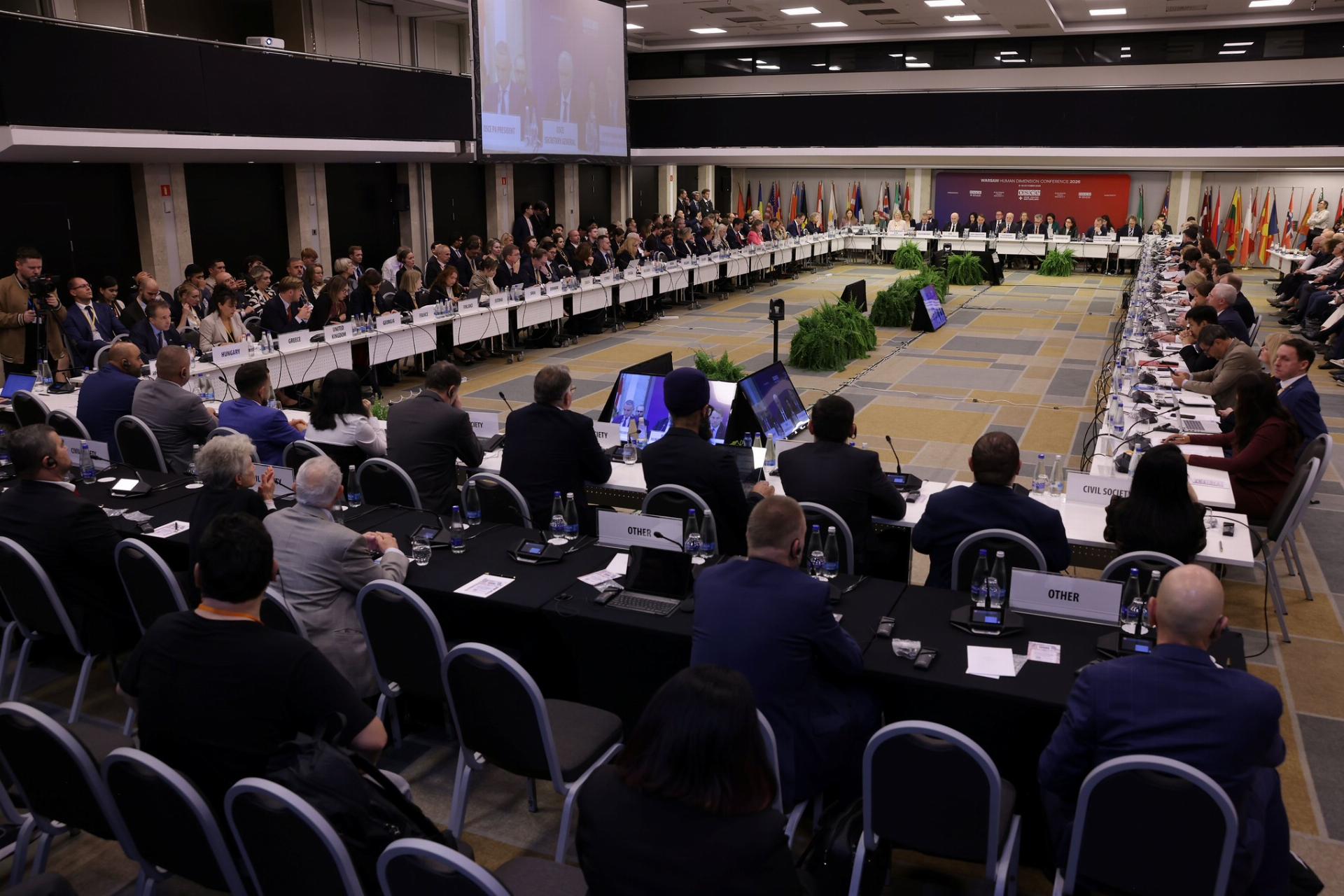
The Permanent Representative of Italy to the OSCE, Ambassador Andrea Cascone, attended the 2026 Warsaw Human Dimension Conference, organized by the Swiss OSCE Chairpersonship with the support of the Office for Democratic Institutions and Human Rights (ODIHR), from 5 to 15 October.
The Conference, the largest annual regional gathering dedicated to human rights, democracy and the rule of law, brought together more than 1,800 representatives of OSCE participating States, international institutions and civil society organizations, providing an important opportunity to review the implementation of commitments undertaken by participating States in the human dimension of the Organization.
The programme featured ten plenary sessions, four roundtables dedicated to the activities of the OSCE Secretariat, autonomous institutions and field operations, as well as numerous side events. Discussions focused on a broad range of issues, including the protection of human rights and fundamental freedoms, the strengthening of democratic institutions and the rule of law, media freedom and the safety of journalists, the promotion of tolerance and non-discrimination, combating trafficking in human beings, gender equality, and the protection of national minorities.
Italy’s participation reaffirmed its strong commitment to the OSCE’s human dimension as an essential component of the Organization’s comprehensive approach to security. In this context, in addition to aligning itself with the statements delivered by the European Union, Italy delivered national statements during the opening session and the sessions dedicated to:
- Humanitarian issues, emphasizing the need for full compliance with the principles of distinction, proportionality and precaution, which are all the more essential in a legal landscape profoundly affected by the impact of emerging technologies;
- Torture and the death penalty, reaffirming Italy’s commitment to the adoption of a universal moratorium on the death penalty, as well as its engagement within the United Nations Human Rights Council as a member for the 2026–2028 term;
- Non-discrimination and tolerance, highlighting Italian initiatives such as the Observatory for Security against Acts of Discrimination (OSCAD) and the National Strategy for Combating Antisemitism 2025–2029, as well as Italy’s continued support for ODIHR’s work in these areas;
- Media freedom and the safety of journalists, recalling Ministerial Council Decision No. 3/18 on the Safety of Journalists, adopted under the Italian OSCE Chairpersonship, and presenting the national coordination mechanism established by the Ministry of the Interior to strengthen structured dialogue between law enforcement authorities and journalists’ associations.
(Picture Credits: OSCE/Piotr Dziubak)